The 10th Regional Meeting of PEN Centres took place in Kyiv
Writers, journalists and cultural figures from Germany, Norway, Romania and Italy came to Kyiv for the 10th Regional Meeting of PEN Centres. They met Ukrainian human rights advocates, writers, civil society representatives and publishers, and visited places affected by Russia’s war.
The Mnozhyna Foundation, together with the National Endowment for Democracy, supported the delegation’s visit as part of its Identity Program. Meetings like this allow international colleagues to hear directly from Ukrainians and to carry their experience back to their own countries.
The visitors were Henrik Hovland, a Norwegian writer, journalist and war correspondent; Cosmin Perța, a Romanian poet, prose writer and essayist and vice-president of PEN Romania; Elena Stancanelli, an Italian writer, journalist and screenwriter and vice-president of PEN Rome; and Astrid Vehstedt, a German theatre director, writer and production designer who leads PEN Germany’s Writers-in-Exile programme.
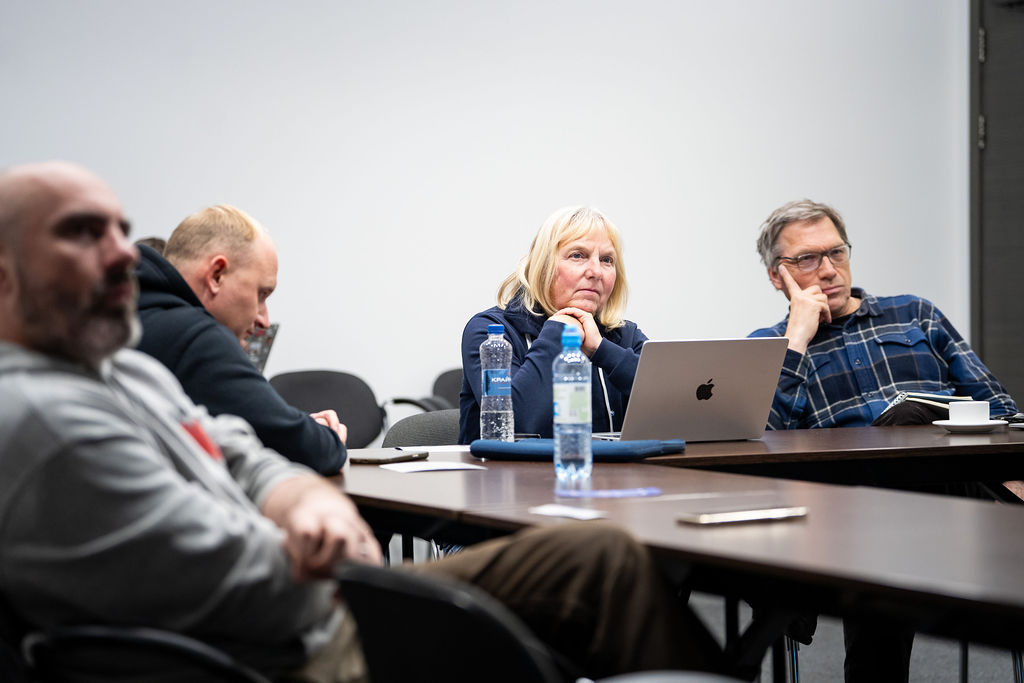
On the first day, the delegation met representatives of Truth Hounds and the Center for Civil Liberties. Anhelina Hrytsai and Olena Pashkovska spoke about documenting war crimes, while Nataliia Yashchuk, Anastasiia Ihnatenko and Anastasiia Holovnenko discussed human rights advocacy. Writer and journalist Yevheniia Podobna presented the project Ukrainian Culture Makers Killed by Russia. The discussion was moderated by Hanna Ustynova, PEN Ukraine’s director of development. Guests also met representatives of Cultural Forces to discuss literary initiatives for service members.

The next day, the group travelled to Bucha, Irpin and Moshchun. Accompanied by Mykhailyna Skoryk-Shkarivska, a community development expert with ISDC, they visited St Andrew the Apostle Church in Bucha, where a mass burial site was located during the occupation; Banksy Square and the destroyed Romaniv Bridge in Irpin; and the Angels of Victory memorial in Moshchun. Village head Vadym Zherdetskyi spoke about the defence of Moshchun. The visitors also met local activists working to preserve the memory of what happened in their communities.
A separate meeting focused on Ukraine’s book sector. Publishers Anton Martynov of Laboratoria, Mariia Zalipa and Yuliia Hashchenko of Osnovy, and Alina Polieshko of Creative Women Publishing discussed how the industry has changed since 2014 and the impact of Russian strikes on printing facilities and warehouses. Figures shared at the meeting showed that shelling destroyed more than 13 million books in the summer of 2026, with losses to the sector estimated at UAH 1.7 billion.
The visitors also learned about Support for Small Ukrainian Publishers, a grant program for small publishing houses launched by Ukraine’s Ministry of Culture, the KSE Foundation, the Ukrainian Book Institute and Book Arsenal. They were invited to spread the word in their own countries and to help attract international support for Ukrainian publishers.
PEN Ukraine has held Regional Meetings since 2014. They bring international colleagues to Ukraine to hear from Ukrainians directly and take that experience back to their own communities.
“For them, this is more than a way of learning about Ukraine from the news. It is a chance to talk to people and to feel the mood of the country during the full-scale war,” says Anastasiia Bezverkha, head of the Mnozhyna Foundation’s Identity Program.
The Identity program supports work that helps Ukraine speak about itself in the international cultural conversation. That means telling the world about Russian crimes and about the people, communities and cultural organisations shaping life in Ukraine. Meetings like this give international writers, journalists and cultural figures first-hand accounts to share with their own audiences.
Photo: Anastasiia Mantach
Related news