Whose Sancho Are You? Philanthropists, Don Quixotes and the Long Game — Key thoughts from a conversation inspired by MUR’s musical Play, Marko!

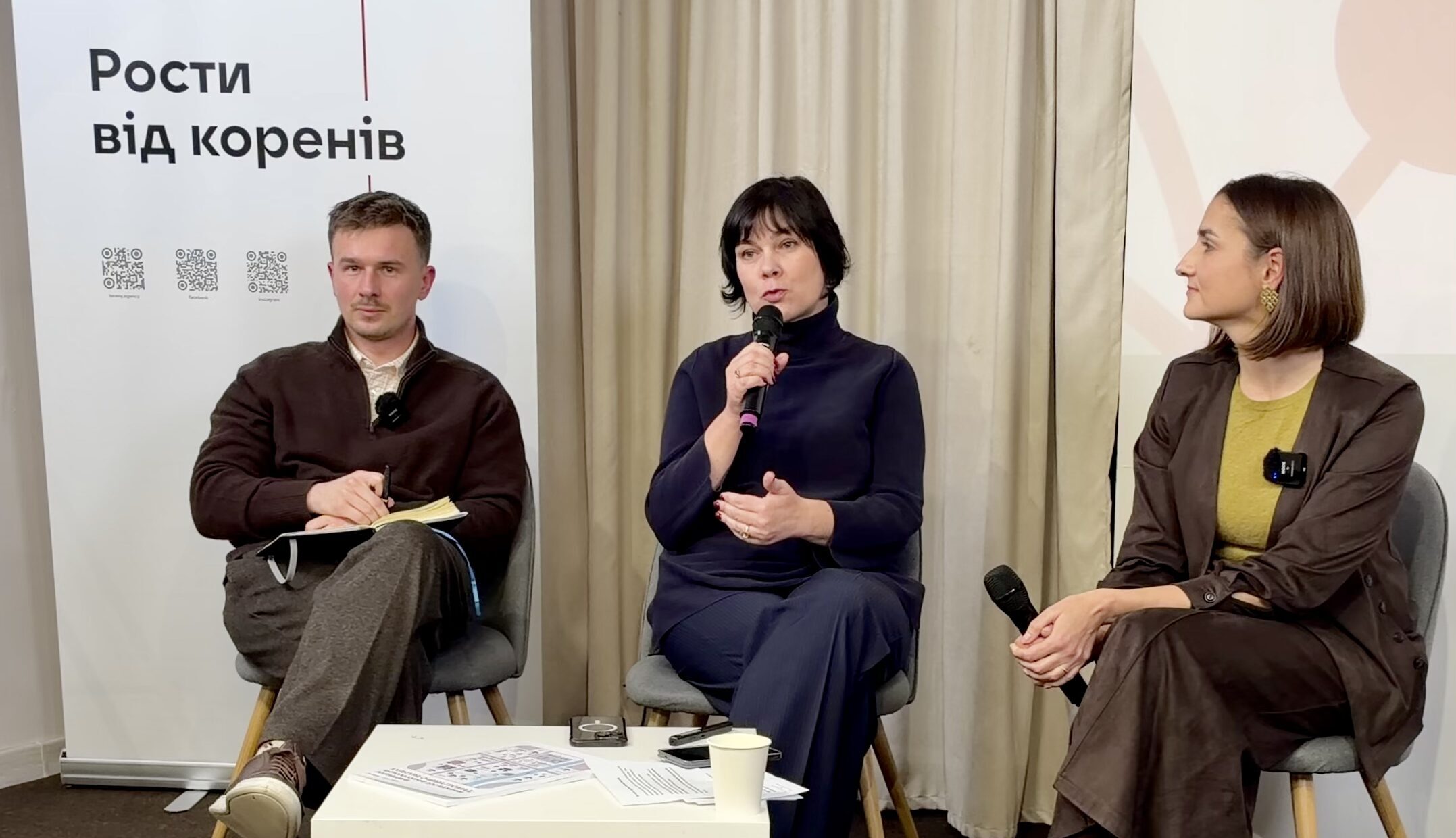
On 29 October, kmbs, the MUR creative association and the Mnozhyna Foundation hosted a conversation about Yevhen Chykalenko, philanthropy and what helps cultural ideas become a shared cause. The speakers were Oleksandr Khomenko, founder of MUR and director of the musical Play, Marko!; Galyna Grygorenko, Head of the Culture Program at the Mnozhyna Foundation; and Tymur Demchuk, Head of Corporate Programs at kmbs and a researcher of Ukrainian philanthropy, who moderated the discussion.
“Nothing material around us has meaning in itself. Don Quixote is the person who gives meaning to what is happening. But someone who thinks about meaning, dreams of the impossible and does ‘crazy’ things cannot stand alone in a system such as a state, a nation or a culture. He needs pragmatic, effective people who know how to get things done and help him move forward with his ideas. Don Quixote, in turn, helps Sancho find meaning in what he does. These are two systemic roles that cannot exist without each other,” said Tymur Demchuk.
Here are some of the ideas that shaped the conversation.
- Ukrainians are entrepreneurs, too
At the start of the event, participants were asked to identify entrepreneurs from their portraits. Henry Ford and Thomas Edison were easy to name. The names of Ukrainian entrepreneurs and philanthropists — Yevhen Chykalenko, the Tereshchenkos, Oleksii Alchevskyi, the Symyrenkos, Brodskyi and Kulzhenko — were much less widely recognised. That contrast helps explain why MUR turned to Chykalenko’s story.
As Oleksandr Khomenko put it, the image of the Ukrainian artist is firmly established in the public imagination, while the entrepreneur who builds a business and invests in culture comes to mind far less often.
“The association ‘Ukrainian — artist’ is already established in the public mind, but ‘Ukrainian — entrepreneur’ is not. The idea that being Ukrainian is also about business, money, investment and building something of your own does not really feature in the public imagination.
And that’s unfair, because we have ingenuity, an entrepreneurial streak. Look around: we keep living, the economy somehow keeps working against all odds, businesses don’t stop, restaurants and cafés stay open. This isn’t about knowing how to write beautiful poetry. It’s about other skills. And Yevhen Chykalenko, I think, is a great illustration of something we rarely talk about: the Ukrainian entrepreneur,” said Oleksandr Khomenko.
-
Ideas need a team
Galyna Grygorenko connected the figures of Don Quixote and Sancho Panza with the way the Mnozhyna Foundation works with cultural initiatives. The aim is not to find lone heroes, but to support teams that bring creative ideas together with the practical ability to make them happen.
“I wouldn’t say we’re looking for Don Quixotes. We’re looking for teams where these roles are balanced, where there are people of ideas and very pragmatic people. Individual Don Quixotes, creative personalities, are a different story, and that always involves more intuition. Chykalenko was fond of Vynnychenko and supported him. But I think there are many people he gave money to whom we simply don’t know about: they didn’t break through, and their names are unknown. His approach was to sow widely and see what would take root. A hundred years later, little has changed.”
For the Foundation, the conversation also resonated with its own history. For many years, Mykola Sushko supported Ukrainian initiatives in education, healthcare, culture and youth development. He and his wife, Anna, later founded the Mnozhyna Foundation to bring this work together in a more structured way. Its four programs share one mission: to help Ukrainians become authors of their own lives.
“Authorship is about agency, capability, desire and, ultimately, opportunity,” said Galyna Grygorenko.
- Culture shapes community
Galyna Grygorenko spoke about culture as the sphere where meaning and ways of interacting are born. It cannot be reduced to leisure or a list of events: culture shapes how a community thinks, what it remembers, whom it regards as heroes and how it sees its future.
“Culture is where meaning is made first, followed by patterns of behaviour and interaction. Whatever happens in the field of culture, it is about how we interact as a community: how we think, what we read, what we watch, what our rules of conduct are, who our cultural heroes are, whom we consider enemies and whom we want to forget. It is a question of national memory. In other words, it is about how we imagine ourselves in the future, how we behave today, and whether our horizontal connections are constructive.”
At the end, Tymur Demchuk recalled the words of Yevhen Chykalenko that gave MUR’s musical its title: “And you, Marko, play on. After us, let others play, but our song will remain the same.”